
Apostille Service in Massachusetts — The Complete Guide for Hague & Non‑Hague Countries
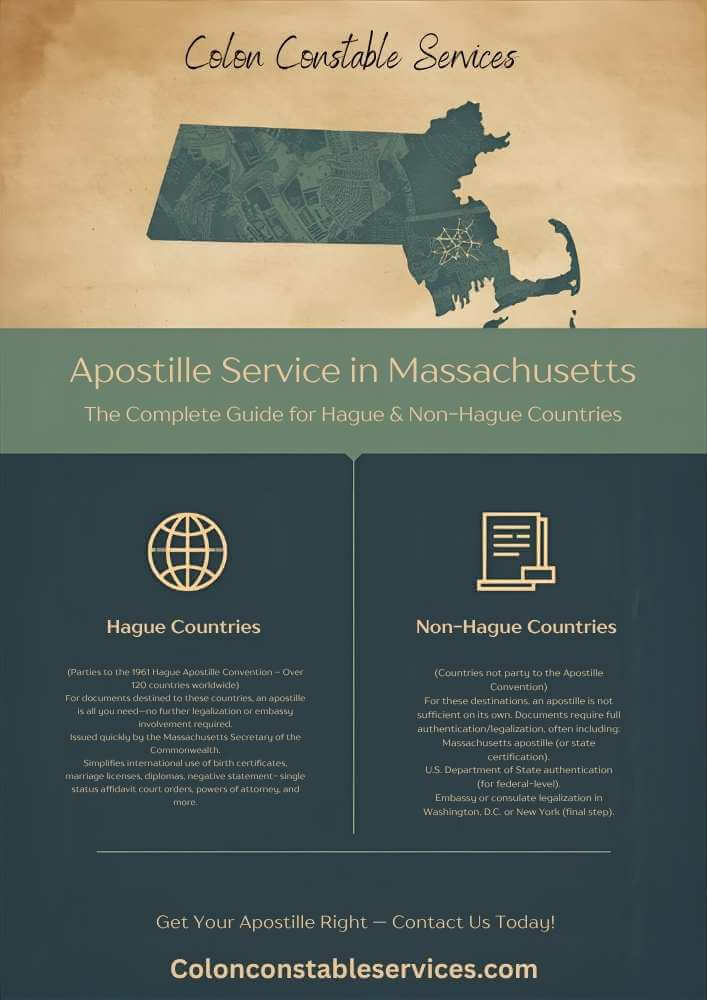
Apostille Service in Massachusetts — The Complete Guide for Hague & Non‑Hague Countries
If you need documents authenticated for use in another country — whether for school, work, immigration, business, adoption, or family matters — understanding the apostille process is crucial. In this complete guide, Colon Constable Services (CCS) explains everything you need to know about Apostille Services in Massachusetts, how the process works, how to get your documents authenticated, the difference between Hague and non‑Hague countries, and what to do if your destination country is not part of the Hague Convention.
What Is an Apostille?
An apostille is a special certificate that authenticates public documents — such as birth certificates, marriage certificates, diplomas, background checks, powers of attorney, and corporate formation records — so they are recognized as valid in foreign countries.
Apostilles are issued under the Hague Convention of 1961, which simplified the process of validating documents for international use between member countries. When a country is part of this treaty, an apostille from a U.S. state — like Massachusetts Secretary of State — is accepted without further authentication.
Why Do You Need an Apostille?
People and organizations need apostilles when they plan to use U.S. documents abroad for: Education & Study Abroad: College transcripts, diplomas, academic records Employment & Work Visas: Professional licenses, background checks Immigration & Visas: Birth certificates, marriage certificates Adoption: Court orders, consent forms Business & Corporate Requirements: Articles of incorporation, contracts Legal Proceedings Abroad: Power of attorney, affidavits
Without an apostille, many countries will not accept U.S. public documents — meaning your application for school, work, immigration, or legal processes could be delayed or rejected.
How Apostille Services Work in Massachusetts
1. Document Preparation Before apostille authentication, your document must be: Properly signed (original signatures) Notarized (when applicable) In the correct format 2. Notarization (If Required) Not all documents require a notary. But many do — for example: Power of attorney Affidavits Personal statements Private contracts
If your document needs a notary, we can handle that for you at CCS.
3. Massachusetts Secretary of State Authentication In Massachusetts, apostilles are issued by the Massachusetts Secretary of the Commonwealth – Public Records Division. Documents must be submitted to this office with the appropriate fee. 4. Mail or In‑Person Service At Colon Constable Services, we can manage the entire process for you: Reviewing documents for correctness Notarizing (if needed) Submitting to the Secretary of State Returning your apostilled documents securely What Types of Documents Can Be Apostilled?
Common documents that people request apostilles for include:
Personal Documents Birth certificates Marriage certificates Death certificates Divorce decrees Wills and trusts Background check reports Educational Documents Diplomas Transcripts Academic certifications Business & Corporate Documents Articles of incorporation Business licenses Contracts Powers of attorney Legal Documents Affidavits Court orders Parental consent letters Hague Convention vs. Non‑Hague Countries
To decide whether your document needs just an apostille or further legalization, you must know whether your destination country is part of the Hague Convention of 1961.
What Is the Hague Convention?
The Hague Convention Abolishing the Requirement of Legalization for Foreign Public Documents (commonly called the Hague Apostille Convention) is an international treaty that establishes a simplified authentication method for public documents. If a country is part of the Hague Convention, your apostilled document from Massachusetts will be accepted there without additional embassy legalization. If a country is not part of the Hague Convention, you usually need: 1. Apostille from Massachusetts 2. Authentication from the destination country’s embassy/consulate 3. Sometimes, translation by a certified translator Complete List of Hague Convention Countries
. The following countries accept apostilles without any legalization:
(Accurate as of 2026 — check with CCS if destination country status changes.)
🇦 A Albania Andorra Antigua and Barbuda Argentina Armenia Australia Austria
🇧 B Bahamas Bahrain Barbados Belarus Belgium Belize Bolivia (Plurinational State of) Bosnia and Herzegovina Botswana Brazil Brunei Darussalam Bulgaria
🇨 C Cabo Verde Canada Chile China (only Hong Kong & Macao) Colombia Costa Rica Croatia Cyprus Czech Republic
🇩 D Denmark Dominica Dominican Republic
🇪 E Ecuador El Salvador Estonia
🇫 F Fiji Finland France
🇬 G Georgia Germany Greece Grenada Guatemala Guyana
🇭 H Honduras Hungary
🇮 I Iceland India Indonesia Ireland Israel Italy
🇯 J Japan Jordan
🇰 K Kazakhstan Kenya South Korea Kosovo Kuwait Kyrgyzstan
🇱 L Latvia Lesotho Liberia Liechtenstein Lithuania Luxembourg
🇲 M Malta Marshall Islands Mauritius Mexico Moldova Monaco Mongolia Montenegro Morocco
🇳 N Namibia Netherlands New Zealand Nicaragua North Macedonia Norway
🇵 P Panama Paraguay Peru Philippines Poland Portugal 🇶 Q Qatar
🇷 R Romania Russia Saint Kitts and Nevis Saint Lucia Saint Vincent and the Grenadines Samoa San Marino Saudi Arabia Senegal Serbia Seychelles Singapore Slovakia Slovenia South Africa Spain Suriname Swaziland (Eswatini) Sweden Switzerland
🇹 T Thailand Trinidad and Tobago Tunisia Turkey Turkmenistan
🇺 U Ukraine United Kingdom United States Uruguay Uzbekistan
🇻 V Vanuatu Vatican City Venezuela
🇿 Z Zambia Zimbabwe
Non‑Hague Countries — Where Apostille Alone Is Not Enough
If your destination country is not part of the Apostille Convention, you will generally need to complete embassy legalization in addition to the apostille.
Common non‑Hague countries include:
Africa Algeria (Until July 2026) Angola Benin Cameroon Egypt Ethiopia Ghana Ivory Coast Kenya (note: Kenya is Hague — check updates) Libya Madagascar Nigeria Sudan Tanzania Uganda Asia Afghanistan Bangladesh Bhutan Brunei Darussalam (sometimes requires extra procedures) Cambodia Iran Iraq Laos Maldives Nepal Pakistan Saudi Arabia (special rules apply) Syria Vietnam (apostille currently not recognized) Yemen Middle East Algeria Egypt Iran Kuwait (special embassy rules) Lebanon Oman Qatar (special rules) Saudi Arabia United Arab Emirates Americas Cuba Dominican Republic (note: DR is Hague — verify current status before submitting) Oceania / Other Solomon Islands Vanuatu (status may vary by document type)
Because non‑Hague countries require additional steps, your process will usually be:
1. Apostille from Massachusetts 2. Authentication by the U.S. Department of State 3. Embassy / Consulate Legalization of the destination country 4. Translation (if required by the destination country) Colon Constable Services handles every step so you don’t need to research embassy rules yourself.
How Embassy Legalization Works (For Non‑Hague Countries)
If your document must be legalized at an embassy, the general process is:
Step 1: Apostille from the Massachusetts Secretary of State We submit your document for apostille certification. Step 2: U.S. Department of State Authentication Some non‑Hague countries require the U.S. federal authentication after the state apostille. Step 3: Embassy Legalization Your document is then taken to the destination country’s embassy or consulate in Washington, D.C. or New York. Step 4: Translation (If Required) Some countries require official translations by a certified translator before acceptance. Step 5: Return of Documents
Once complete, your documents are returned to you — ready for use abroad.
CCS manages all these steps to save you time, effort, and confusion. Common Documents We Apostille
At Colon Constable Services, we process apostilles for:
Personal Birth certificates Marriage certificates Death certificates Divorce decrees Police background checks FBI fingerprint reports Legal Power of attorney Affidavits Court orders Guardianship papers Education Diplomas Transcripts Letters of recommendation Certification credentials Business Articles of organization Corporate resolutions Business licenses Contracts CCS Apostille Service — Why Choose Us?
✅ Fast, Accurate, and Reliable We review your documents before submission to avoid delays.
✅ Full Service We handle every step: notarization, submission, tracking, pickup, and return.
✅ Expert Guidance We help determine whether your destination country is Hague or non‑Hague and explain exactly what is needed.
✅ Secure & Confidential Your documents are handled with professionalism and security at every stage.
✅ Affordable and Transparent We offer clear pricing and service options — no hidden fees. How To Start Your ApostilleRequest with CCS
1. Contact Us: Tell us which document you need apostilled and the destination country
2. Prepare Documents: We’ll guide you on what’s needed
3. Submit to CCS: Mail or drop off your documents
4. We Process Them: From notary (if needed) to apostille
5. Receive Back: Your documents returned ready for international use Questions to Ask Before You Request an Apostille
To make sure you get the right service, prepare the following information: What type of document do you have? Is it an official/public document or a private document? Do you need a notary before authentication? Which country will accept the document? Is translation required? Colon Constable Services answers all these questions for you — so you never have to guess. Final Notes — Apostille vs. Embassy Legalization
Situation Hague Country Non‑Hague Country
Apostille Required? Yes Yes Embassy Legalization Required? No Usually Yes U.S. Dept. of State Authentication Needed? No Often Yes Translation Required? Sometimes Often Yes
Working with a trusted apostille service ensures your documents are accepted quickly and correctly. Whether you are applying for admission to a foreign university, preparing international legal documents, getting a foreign work visa, or submitting official records to a government abroad, apostille authentication matters. With so many countries around the world, knowing which ones accept apostilles and which require additional embassy legalization can be confusing — but you don’t have to figure it out alone.
Colon Constable Services (CCS) provides full apostille support in Massachusetts — including handling Hague and non‑Hague document requirements, embassy legalizations, translations, and complete end‑to‑end service.
📩 Ready to Get Started? Contact us today with your document details and destination country to begin your apostille in Massachusetts.apostille in Massachusetts.


Comments